

The Silent Threat: What Every Homeowner Needs to Know About Foundation Water Leaks
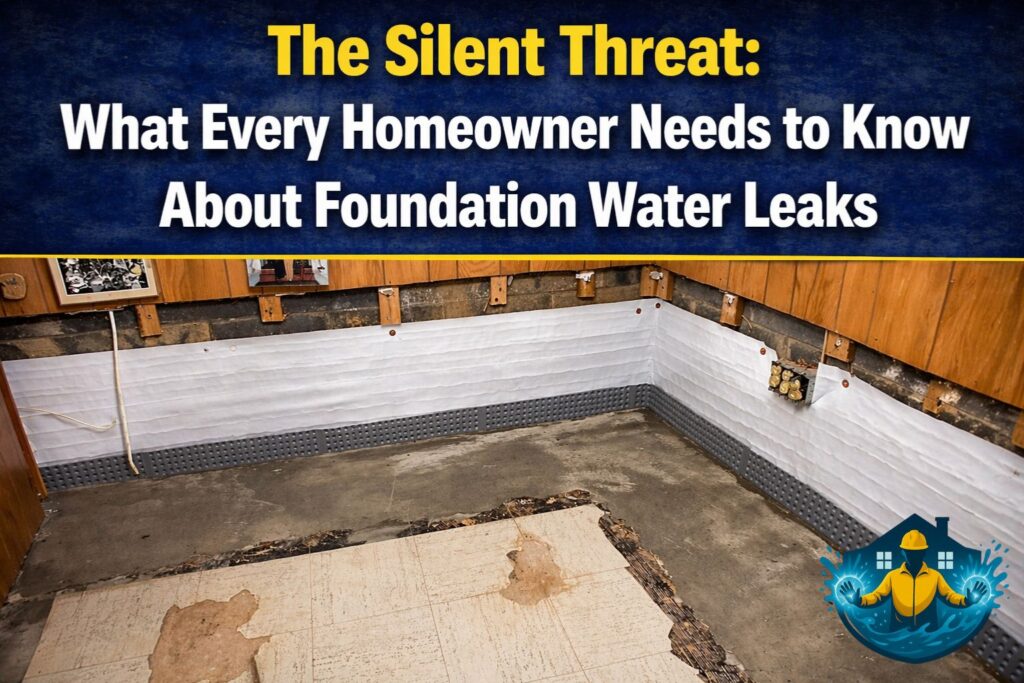
Why Do So Many Serious Basement Problems Start With a Foundation Water Leak?
Because water can slip through tiny cracks, joints, or even porous concrete long before you notice major damage. Don’t ignore the early signs. A foundation water leak is water entering through your foundation walls or floor, and understanding it now can help protect your home. Here’s what Premier Basement Waterproofing wants every homeowner to know:
- Common signs: Damp walls, white chalky deposits (efflorescence), musty smells, mold, and visible cracks
- Main causes: Hydrostatic pressure, poor yard drainage, clogged gutters, and expansive soils
- Entry points: Wall cracks, the joint where the wall meets the floor, porous concrete, and below-grade windows
- Risk level: Even a small leak can escalate into structural damage, mold growth, and costly repairs if ignored
- Fix options: Range from DIY drainage improvements to professional waterproofing and crack injection
Water always finds the path of least resistance — and your foundation is often that path.
Most homeowners don’t notice a foundation leak until the damage is already spreading. A damp corner. A musty smell that won’t go away. A crack that seemed small last year but looks different now. These are early warning signs that something is wrong below the surface.
Left unaddressed, foundation leaks don’t just stay leaks. They lead to mold, weakened walls, damaged belongings, and in serious cases, structural failure.
I’m Nelson Manso, owner of Premier Basement Waterproofing and a licensed waterproofing and foundation repair specialist with 29 years of hands-on experience diagnosing and fixing foundation water leaks in Monmouth County, New Jersey. In this guide, I’ll walk you through everything you need to know — from spotting the early signs to choosing the right fix for your home.
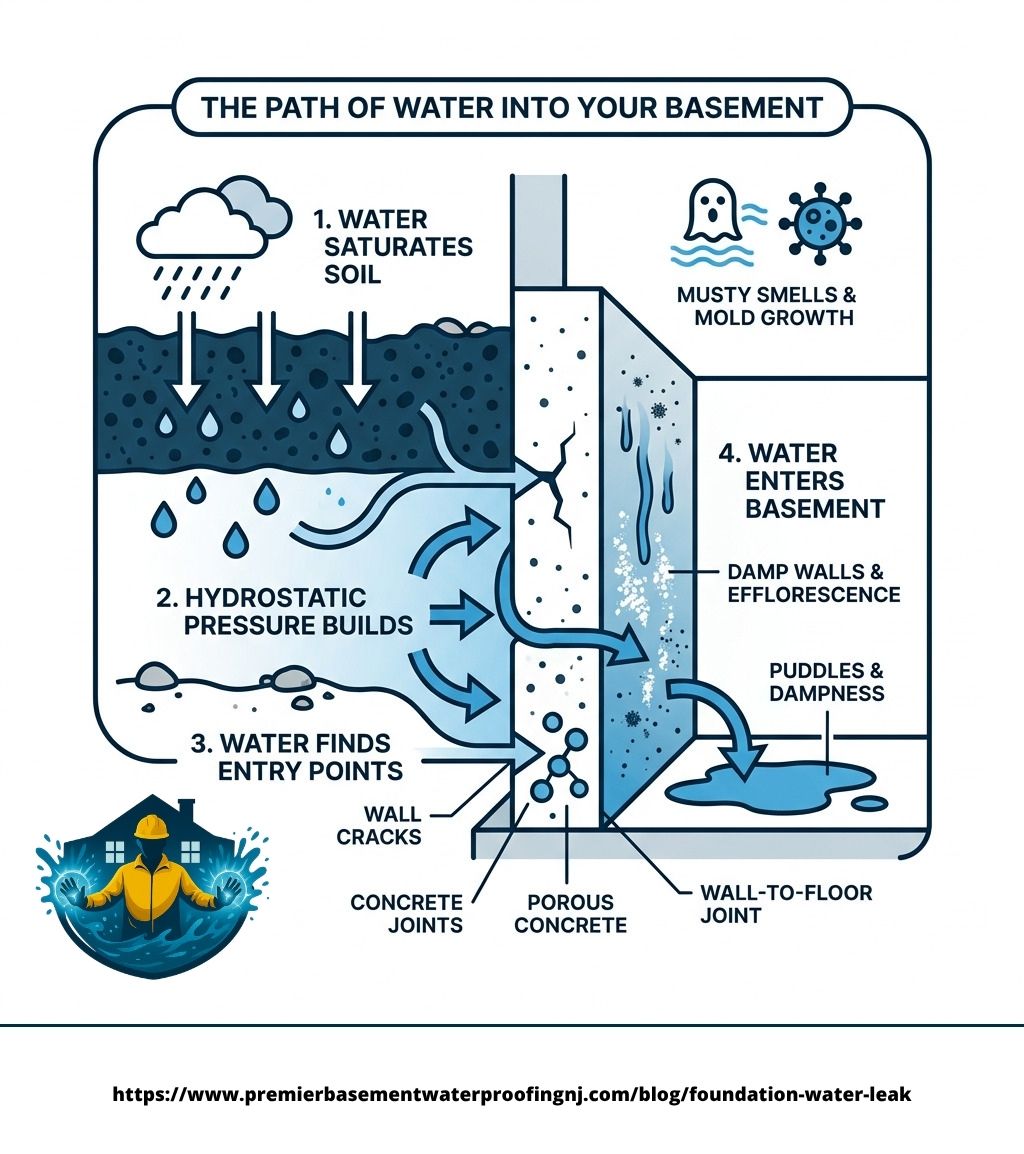
Identifying and Understanding Your Foundation Water Leak
When I visit homes in Freehold or Colts Neck, the first thing I do is look for the source. Identifying a foundation water leak isn’t always as simple as finding a puddle. Water is sneaky. It can travel behind finished walls or under floorboards for weeks before you see a single drop.
To truly understand why your basement is wet, we have to look at the science of the soil surrounding your home. Most foundation issues in New Jersey are driven by three main forces: hydrostatic pressure, the “clay bowl effect,” and expansive soils.
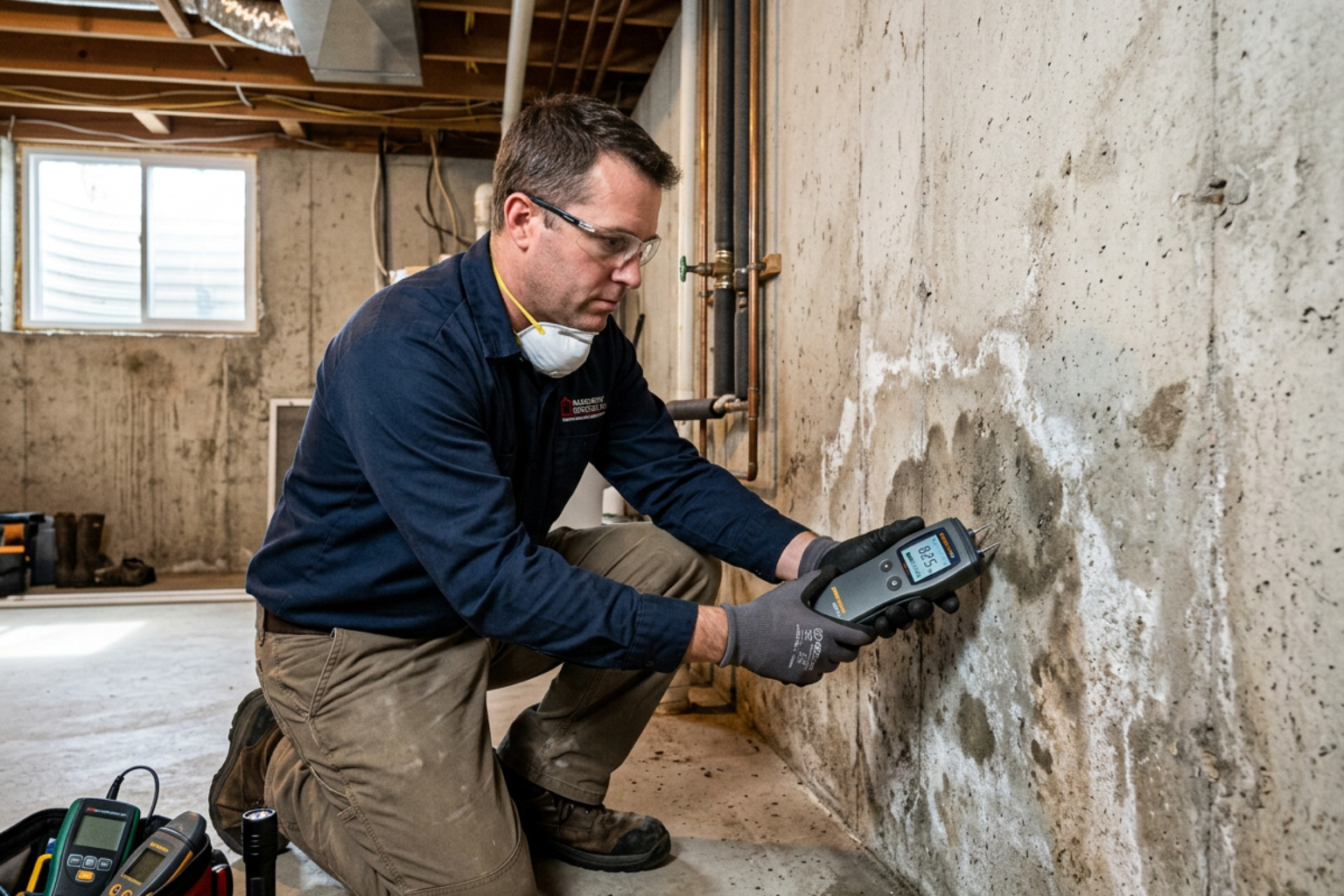
The Science of Water Intrusion
- Hydrostatic Pressure: Think of your foundation like a boat sitting in a lake of saturated soil. When it rains heavily in Monmouth County, the soil becomes heavy with water. This water exerts thousands of pounds of pressure against your foundation walls. Eventually, that pressure forces water through even the tiniest hairline cracks or porous concrete.
- The Clay Bowl Effect: When your home was built, a hole was dug larger than the foundation. After the walls were poured, the space around them was backfilled with loose soil. This backfilled soil is less dense than the undisturbed “virgin” soil around it. This creates a literal “bowl” that collects water right against your home.
- Expansive Soils: Many areas in New Jersey have soil with high clay content. These soils expand when wet and shrink during droughts. This constant “push and pull” creates movement that causes foundation cracks, which then become highways for a foundation water leak.
If you want a broader homeowner-focused overview of how moisture moves through foundations and why leaks happen, the U.S. Environmental Protection Agency offers helpful guidance on moisture control at home.
Common Signs of a Foundation Water Leak
You might not see a “gusher,” but your home is likely talking to you. Here are the symptoms I tell my clients in Manalapan and Rumson to watch for:
- Efflorescence: Have you noticed a white, powdery, or chalky substance on your basement walls? That’s efflorescence. It happens when water evaporates and leaves behind mineral deposits. It is a “smoking gun” for moisture intrusion.
- Musty Smells: That “basement smell” isn’t normal—it’s the scent of mold and mildew growing in damp dark spaces.
- Cracks: Horizontal cracks or “stair-step” cracks in block walls are major red flags. Even vertical hairline cracks can leak during a heavy New Jersey downpour.
- Dark Stains: If the bottom of your drywall or the base of your concrete walls looks darker than the top, water is wicking up from the ground.
Basement vs. Slab Foundation Leaks
It’s important to know what kind of foundation you have, as the leaks behave differently.
| Feature | Basement Foundation Leak | Slab Foundation Leak |
|---|---|---|
| Primary Cause | Hydrostatic pressure / Surface drainage | Pipe corrosion / Soil shifting |
| Common Sign | Wet walls, floor-wall joint seepage | Warm spots on floor, high water bills |
| Detection | Visual inspection of walls/floor | Water meter tests, acoustic equipment |
| Risk | Structural bowing, mold, flooding | Foundation “heave,” sudden floor damage |
Differentiating Between Foundation Issues and Plumbing Leaks
I’ve seen many homeowners in Middletown and Holmdel panic thinking their foundation is failing, only to find out a pipe has a pinhole leak. On the flip side, some think they have a plumbing problem when they actually have a foundation water leak.
How can you tell the difference?
- Check the Water Meter: Turn off all faucets and appliances. If the meter is still spinning, you have a plumbing leak (likely under the slab).
- Look at the Windows: If water is only appearing under a window, check the window well. Clogged window wells are a frequent culprit that mimics foundation failure.
- Condensation: If the walls are damp all over, it might just be high humidity. Try the “foil test”—tape a piece of foil to the wall. If moisture forms on the outside of the foil, it’s humidity. If it forms underneath the foil, the wall is leaking.
For a more detailed breakdown, check out our In-Depth Guide to Basement Leak Repair.
The Impact of Soil and Yard Grading
In the waterproofing world, we have a saying: “Manage the water outside, and you won’t have to fight it inside.” Your yard grading and gutter system are your first line of defense against a foundation water leak.
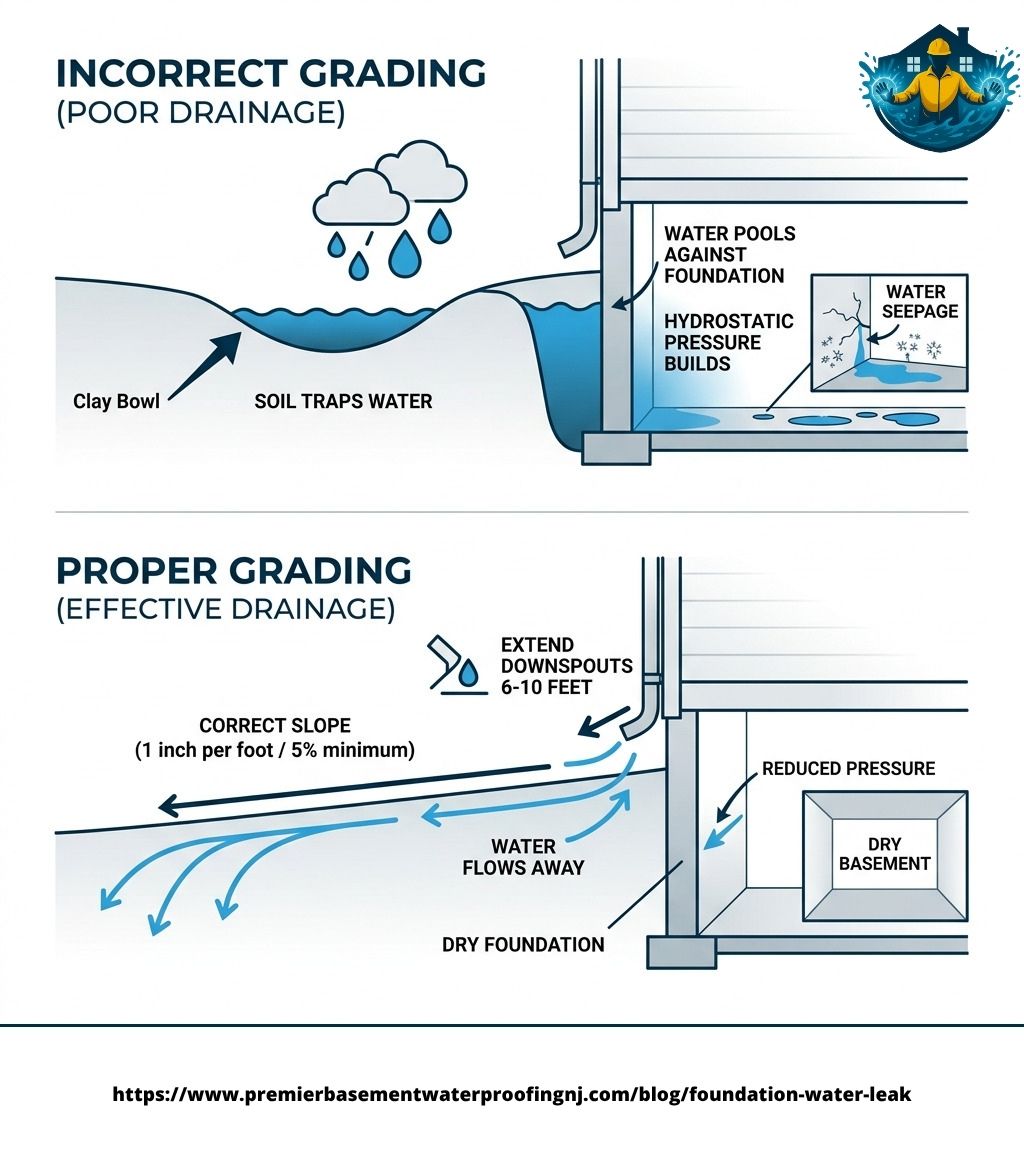
If your yard slopes toward your house, you are essentially funneling every gallon of rain directly into that “clay bowl” we discussed earlier. Similarly, if your gutters are clogged or your downspouts drop water right at the base of your foundation, you are inviting a leak.
I always recommend extending downspouts at least 6 to 10 feet away from the house. In places like Howell or Millstone where properties are larger, we often install Drainage Solutions like French drains or dry wells to move that water even further away.
Professional Solutions and Prevention Strategies
Once a foundation water leak has been confirmed, the “wait and see” approach is the most expensive mistake you can make. Water damage is progressive. What starts as a small crack can turn into a bowed wall that requires thousands of dollars in structural reinforcement.
Effective Repair Methods for a Foundation Water Leak
There isn’t a “one-size-fits-all” fix. The right solution depends on whether the issue is structural or just a matter of seepage.
- Crack Injections (Polyurethane or Epoxy): For solid concrete foundations, we can inject specialized resins into the crack. Polyurethane is fantastic because it expands to fill the entire void and remains flexible as the house shifts.
- Interior Drainage Systems: This is often the most reliable “permanent” fix. We create a trench around the interior perimeter, install a perforated pipe (French drain), and lead it to a high-powered sump pump. This relieves the hydrostatic pressure before it can ever touch your floor.
- Carbon Fiber Straps: If the water pressure has caused your walls to bow or lean, we use carbon fiber. These straps are stronger than steel and are bonded to the wall to stop any further movement.
- Exterior Waterproofing: This involves excavating the soil around your home, cleaning the wall, and applying a waterproof membrane. It’s labor-intensive but creates a literal “raincoat” for your house.
For a broader overview of practical repair methods and drainage basics, see the EPA’s moisture control guidance and visit our Foundation Repair page.
The Risks of DIY vs. Professional Intervention
I love a good DIY project as much as the next guy, but the foundation is not the place to “wing it.” I often see homeowners try to fix a foundation water leak with hydraulic cement from a big-box store.
The problem? Hydraulic cement is rigid. Your house is constantly moving. Within a year, that patch will likely pop out or crack, and the leak will return—often worse than before.
While a basic exterior fix like adding a downspout extension is a great DIY task, structural repairs are different. According to industry data, a professional exterior foundation repair for a small section can cost around $3,800, but that investment protects the tens of thousands of dollars in value of your home’s structure.
If you’re considering a DIY fix, read our Foundation Waterproofing Guide first to understand the complexities involved.
Long-Term Prevention and Premier Basement Waterproofing
At Premier Basement Waterproofing, we don’t believe in high-pressure sales. We believe in education. Whether you are in Freehold Borough or Sea Girt, our goal is to give you an honest assessment of your home’s health.
Our 4-step process ensures that we don’t just treat the symptom (the water), but we fix the cause (the pressure and entry points). We look at your grading, your gutters, your sump pump health, and your wall integrity.
How to Prevent Future Leaks:
- Clean your gutters every spring and fall.
- Check your grading: Ensure the soil drops at least 6 inches over the first 10 feet away from your foundation.
- Monitor cracks: If you can fit a dime into a crack, it’s time to call a pro.
- Annual Inspections: Just like your car, your basement needs a check-up to ensure your sump pump is ready for the next Jersey storm.
Do not let a foundation water leak quietly put your home at risk. If you have noticed warning signs, or simply want to better understand what is happening beneath your home, Premier Basement Waterproofing is here to help. Contact us today for a professional evaluation and clear next steps that protect your home and your peace of mind.
