

Drain Tile vs French Drain: What NJ Homes Actually Need
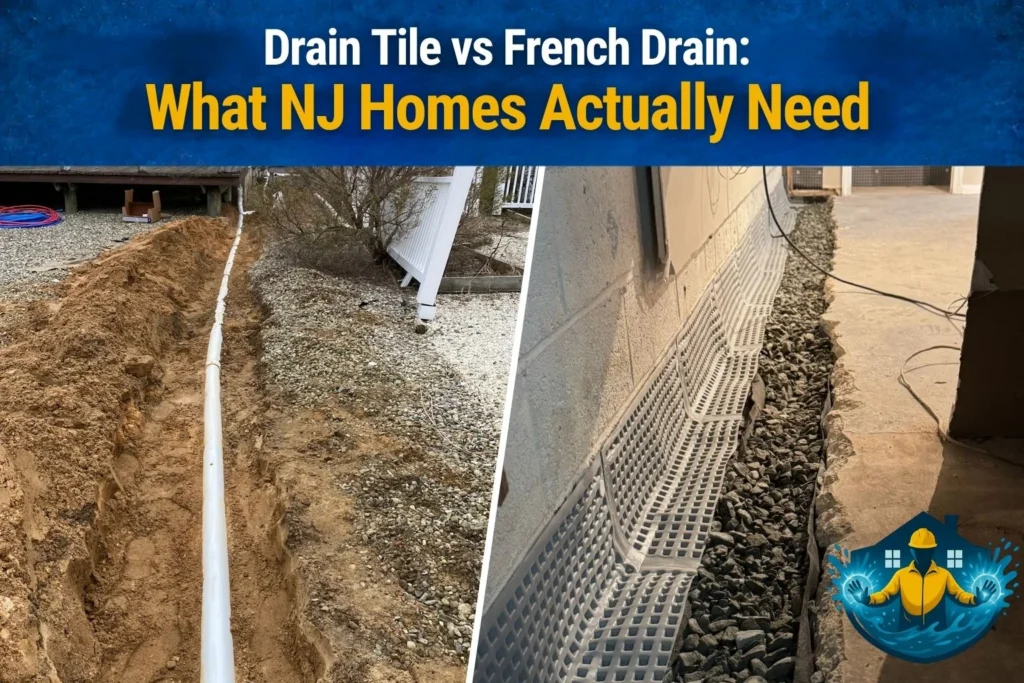
When your basement gets wet while it is still raining, the water is arriving across the surface. When dampness appears a day or two following a storm, the water is arriving from below. Those two patterns call for different drainage systems, and you can tell them apart yourself.
This guide explains how to identify your water source, why the ground under Freehold makes the solution vary by property, what each system accomplishes, and where the water goes once collected.
Watch When the Water Shows Up
Surface water and groundwater produce similar symptoms while requiring different solutions. Timing separates the two sources, and you can run both of these observations during ordinary weather.
The Puddle Test
Observe your property during a heavy rainstorm. When water pools on the lawn, the driveway, or near the garage during the rainfall, and those puddles vanish within a few hours of the storm passing, you are dealing with surface water.
Surface water arrives rapidly and leaves rapidly. It sits on top of soil that lacks the capacity to absorb it quickly, moving based on the natural slope of your lot.
The Timing Test
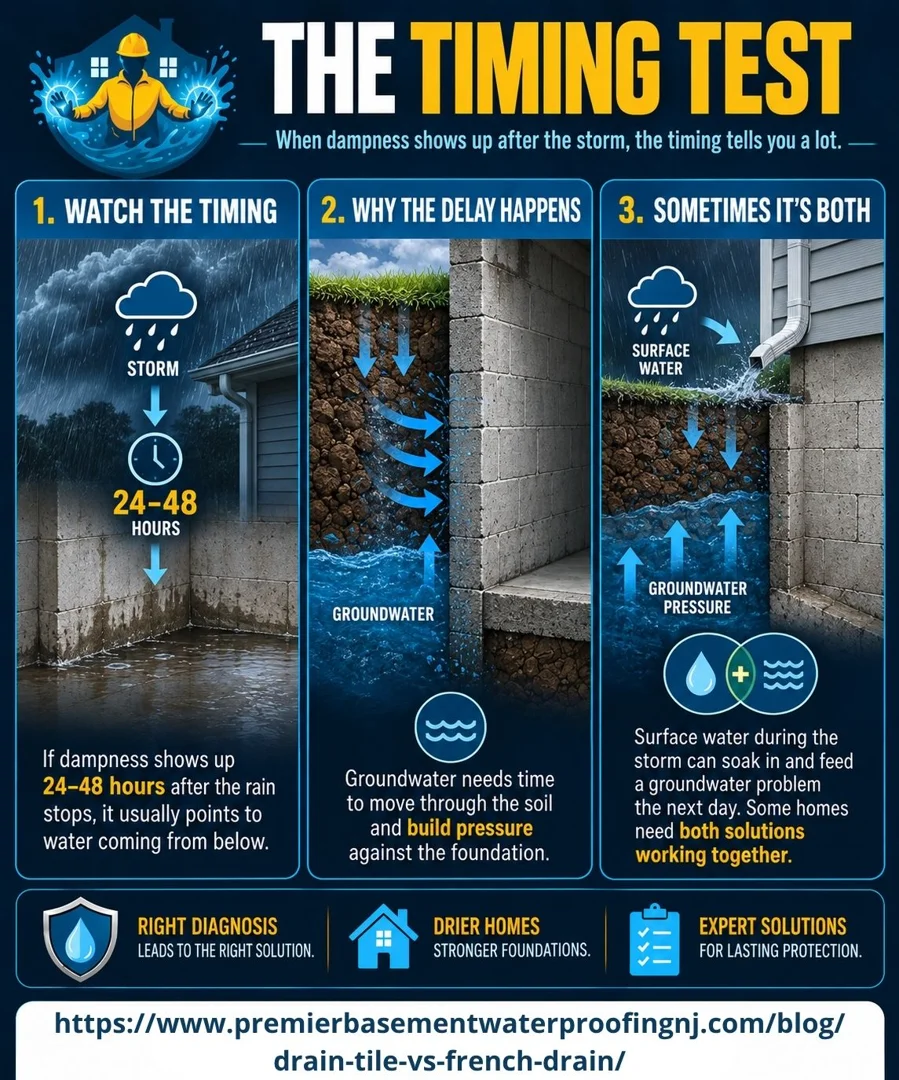
Next, observe the basement. When dampness appears on walls or at the floor joint 24 to 48 hours following the end of a storm, the water is arriving from below. Our guide to basement moisture control covers what that pattern looks like over a season.
That delay provides the entire signal. Groundwater requires time to rise through the soil and build pressure against the foundation, so the basement gets wet after the weather has cleared.
A single house can experience both issues. Surface water pooling against the foundation during a storm soaks into the earth, contributing to a groundwater problem the following day. For this reason, some properties need both systems working together.
The Soil Under Freehold Changes Street to Street
New Jersey soil is described as heavy clay. The ground under Monmouth County has more specific characteristics, and those details matter.
The USDA classifies the Freehold soil series as well-drained with moderate permeability. The Monmouth series is also well-drained, forming in fine-textured marine sediment high in glauconite, which is the greensand native to this part of the state.
Those well-drained soils make up the uplands. Sitting alongside them on lower-lying landforms and flats are soils the USDA classifies as poorly drained, including Colemantown, Fallsington, Shrewsbury, and Elkton. The Adelphia series sits between the two as moderately well-drained.
Drainage conditions therefore change over short distances. A house on a gently sloping upland and a house a few streets away on flat terrain can have different relationships with water, which is visible across the townships we serve, which makes a neighbor’s successful solution a poor guide for your own home. That variation is why a professional assessment starts by evaluating the specific parcel and works toward the drainage system.
What Each System Does
Both systems use perforated pipe surrounded by stone, which leads many people to use the names interchangeably. The differences involve depth, position, and the kind of water each one intercepts. One system sits near the surface where water crosses the property. The other sits at the foundation where water has already arrived.
A French Drain Handles Surface Water
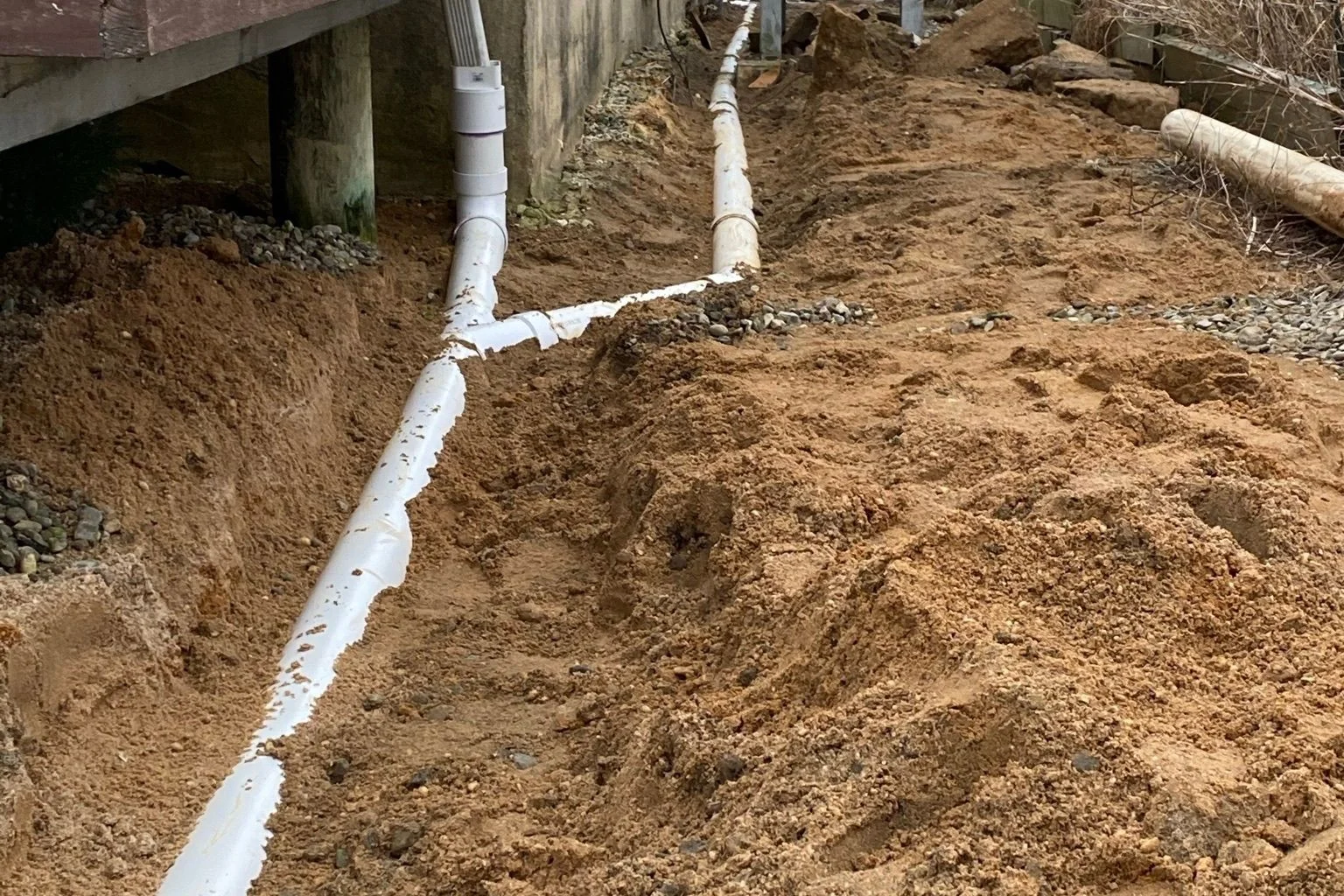
A French drain is a trench holding perforated pipe bedded in stone, positioned where water collects or along its path across the property. Water enters through the stone, reaches the pipe, and runs by gravity to a discharge point.
Our team installs professionally engineered systems using 3- or 4-inch perforated pipe encased in up to 12 inches of blue stone, wrapped in non-woven laminated barrier fabric.
This is the system for standing water on a lawn, runoff heading toward the house, soggy ground surrounding a patio, and soil erosion caused by heavy rain. Our guide to French drain installation walks through the work in detail.
Drain Tile Handles Groundwater
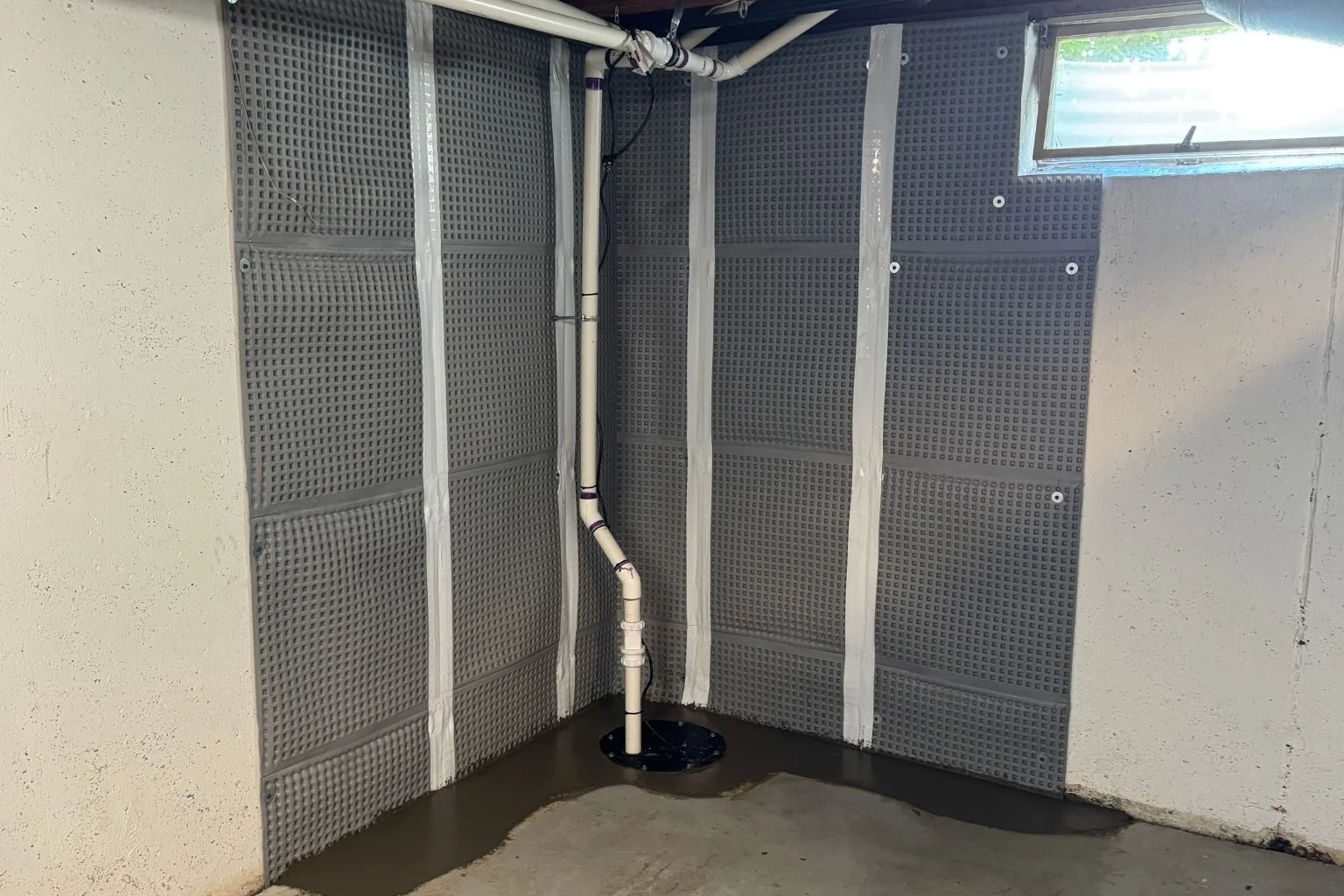
Drain tile is a deeper system sitting at the foundation, located either outside along the footing or inside beneath the edge of the basement slab. Its job involves relieving the pressure of water that has already reached the foundation walls.
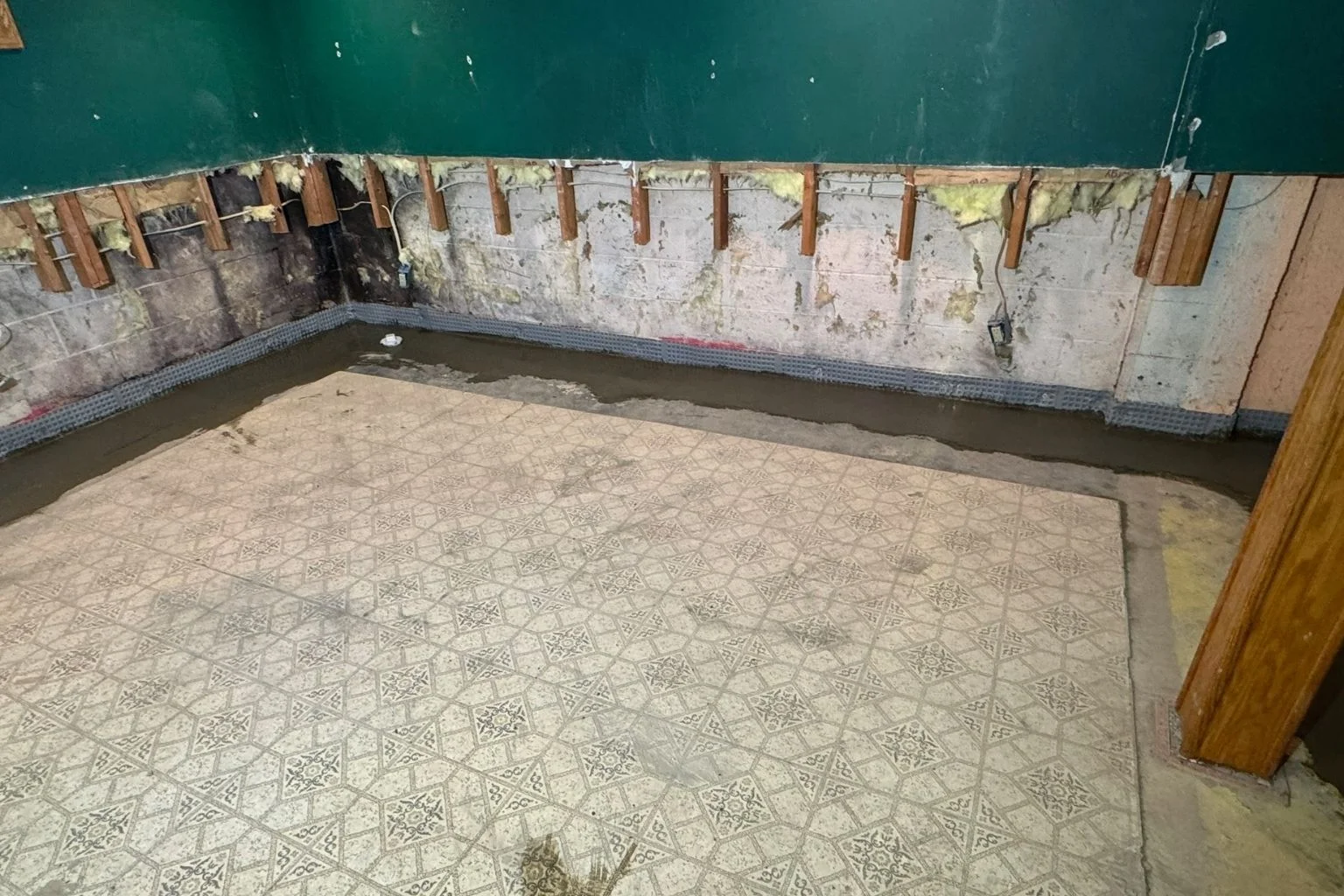
An interior system involves cutting the perimeter of the concrete floor, placing the pipe in a stone bed below the slab, and channeling the collected water to a sump pump system. We set our sump pits at a depth of 16 to 18 inches.
This is the system for seepage at the wall and floor joint, dampness appearing after the weather has cleared, and recurring basement moisture on a property with a high water table.
Where the Water Goes After It Is Collected
Collecting the water is the part most often discussed. Discharging it determines whether the system works, and your lot dictates the available options. Our drainage solutions cover the arrangements below, and we have written about seven approaches to drainage in New Jersey separately.
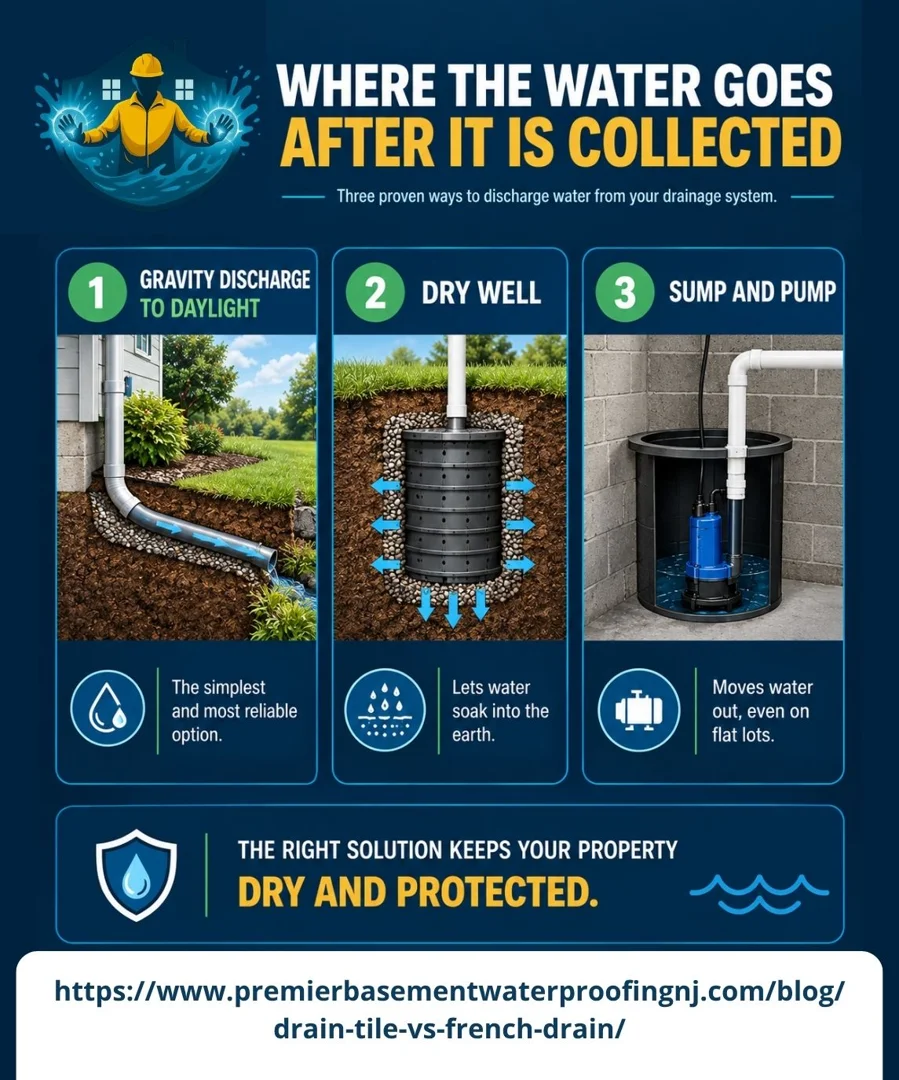
- Gravity discharge to daylight. The simplest and most reliable arrangement, since it involves no moving parts. It requires a sufficient downward slope across the property to carry water to an outlet that stays open.
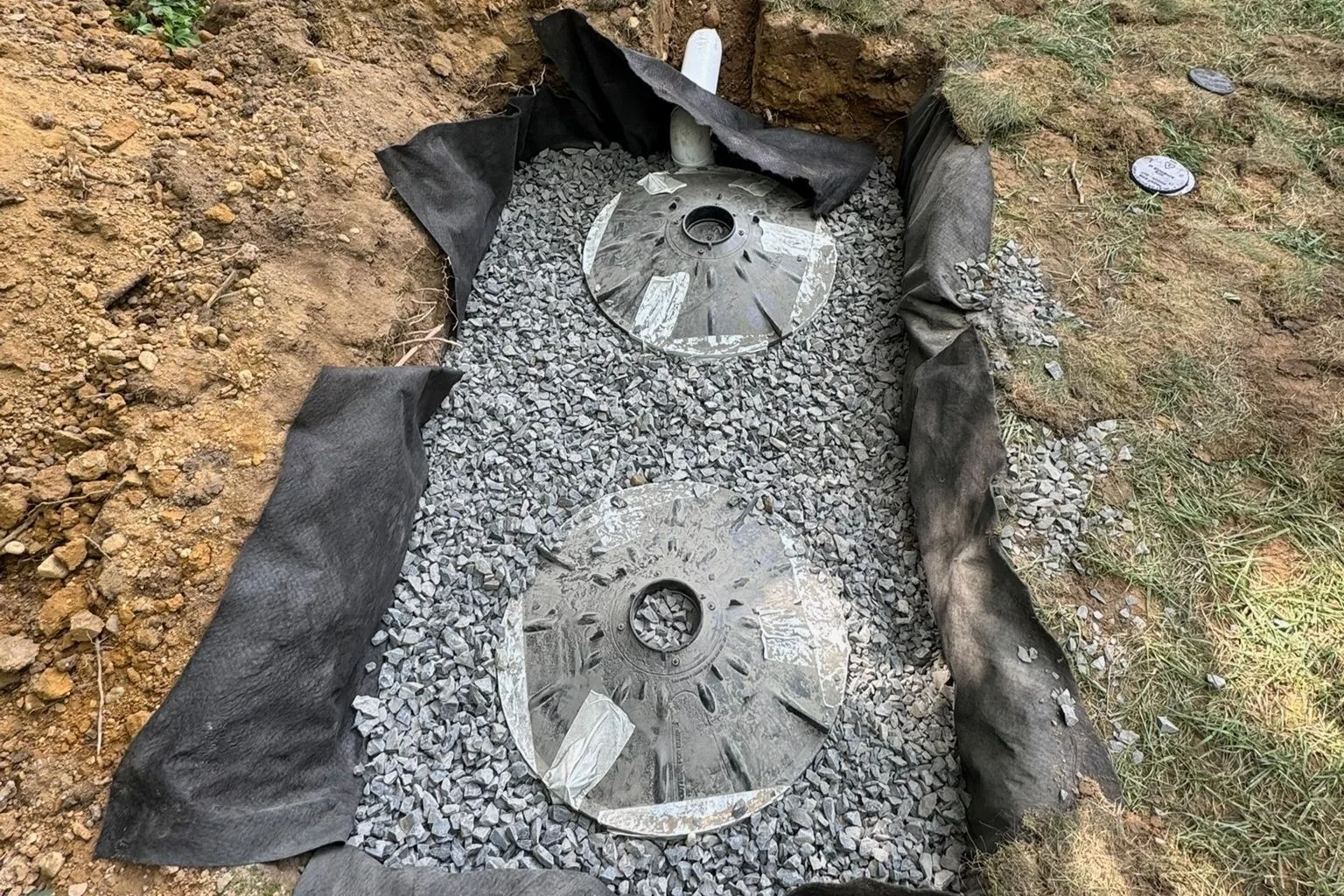
- A dry well. Water is directed to a buried chamber and allowed to soak away into the surrounding earth. This depends on having soil capable of accepting the moisture, so on a poorly drained parcel a dry well recreates the original pooling problem in a new location.
- A sump and pump. The standard for interior systems and for flat lots lacking sufficient natural slope. It introduces a mechanical component and a dependency on electrical power, which matters during the storms that produce the most water. A battery backup covers the outage.
Discharge placement also needs planning to keep water away from neighboring properties and out of areas that freeze during the winter.
Settling the discharge point early shapes the rest of the design. A system planned around an outlet that turns out to be unworkable gets redesigned at the worst possible moment.
Frost Depth in Freehold
A shallow drain that freezes stops working during the season you rely on it most.
The New Jersey Uniform Construction Code, within the One and Two Family Dwelling Subcode, establishes the frost depth at 30 inches for southern New Jersey and 36 inches for the northern region.
Monmouth County falls into the southern classification, making 30 inches the figure that applies across Freehold and the surrounding townships.
That depth affects shallow pipe runs and discharge outlets. Outlets can freeze at the daylight point even when the buried portion remains fully operational, so keeping them unobstructed matters through the winter.
How These Systems Fail
Every buried drainage system has a service life, and a few factors typically bring it to an end.
- Silt migration. Fine soil works its way into the stone and then into the pipe, gradually reducing the carrying capacity. Filter fabric slows this down, which makes the choice of fabric worth asking about.
- Root intrusion. Tree roots seek out pipe joints and perforations, particularly near mature trees. A pipe filled with roots loses its ability to move water.
- Crushed or collapsed pipe. Soil settlement or heavy equipment driven over a shallow run during later landscaping work.
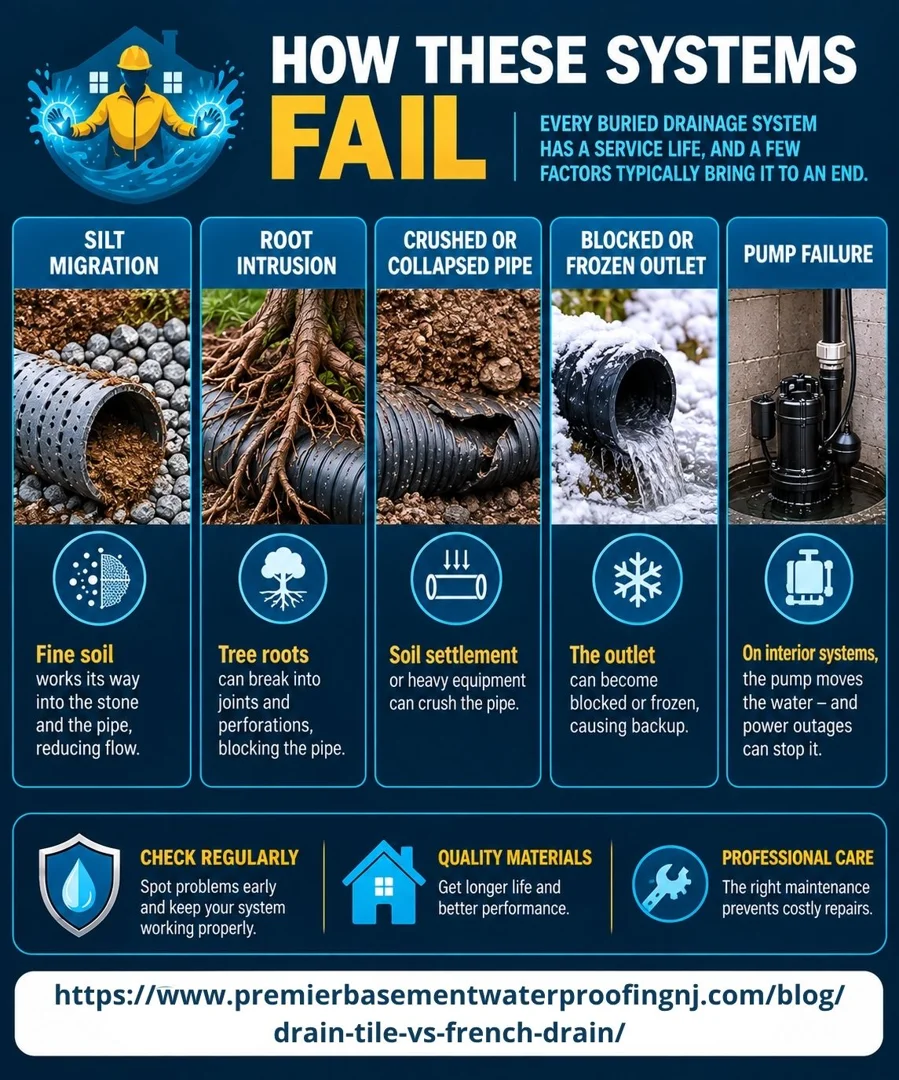
- A blocked or frozen outlet. The buried run stays open while the trapped water backs up into the yard or basement.
- Pump failure. On an interior system, the pump is the component moving the water, and power outages arrive alongside the heavy rain that fills the pit. A noisy or failing check valve is often the first warning.
A technician can view most of these using a pipe camera, which is worth knowing when an older system has slowed down.
What Is Already Under an Older Home
Many homes in the area already have some form of perimeter drainage installed during the original construction. Older systems used clay tile laid in sections, and those materials age differently from modern perforated pipe. Over the decades, the clay sections shift, the joints open, and roots and silt enter the line.
A homeowner standing in a wet basement frequently lacks the information to know whether an underground system has failed, whether the builders omitted one entirely, or whether a working system is simply overwhelmed. That question is answerable without guessing, and answering it first helps you pursue a targeted repair where one will do.
Frequently Asked Questions
Is Drain Tile the Same as a French Drain?
They use similar materials and solve different problems. A French drain intercepts surface water as it moves across the property. Drain tile sits at the foundation and relieves groundwater pressure, which is part of a wider basement waterproofing approach.
Can I Have a French Drain and Drain Tile Together?
Yes, and many properties benefit from having both. Surface water reaching the foundation soaks into the earth and adds to the groundwater volume, so handling both sources covers the whole problem.
Why Does My Basement Get Wet Days After Heavy Rain?
That delay points to groundwater rising and building pressure against the foundation walls. It is the pattern a drain tile system addresses.
Does an Interior System Mean Digging Up My Floor?
Installing an interior system involves cutting the perimeter of the slab, placing the pipe below it, and restoring the concrete. The work stays at the edges of the floor, leaving the center of the room undisturbed.
What Happens if My Yard Has Nowhere to Drain To?
This is a common situation on flatter lots, and it shapes the design approach. A sump and pump covers properties lacking sufficient downward slope for gravity discharge.
How Do I Find Out What Drainage My House Already Has?
A scheduled assessment establishes whether an underground system exists and evaluates its condition. That evaluation determines whether your home needs a repair or a new installation.
Talk to Premier Basement Waterproofing
Premier Basement Waterproofing is an owner-operated company in Freehold, serving Monmouth County and the surrounding townships. You can see completed work in our gallery and read what customers say in our reviews. The owner runs the assessments personally, which means the person diagnosing the problem is the person answering for the recommendation, without commissioned salespeople involved.
You have already done half the diagnosis. If you know when the water shows up relative to the rain, you know which of the two systems to be asking about.
Get in touch with what you have seen, where the moisture appears, and roughly when the house was built. We come out, look at the parcel and at whatever drainage is already down there, and tell you whether it needs a repair or a new system.
